
[1]:
from arc import *
from time import time
import numpy as np
from matplotlib.gridspec import GridSpec
import matplotlib.pyplot as plt
%matplotlib inline
Angular Channel Code for PairStateInteraction class#
Compare interaction matrices obtained via the different approaches and computation speed for a single C6 calculation#
[3]:
# set atom properties
atom = Cesium()
n, l, j, mj1 = 63, 0, 0.5, 0.5
nn, ll, jj, mj2 = 90, 2, 2.5, 0.5

# set calculation properties
nrange, dE = 10, 1*1e12
stateHop = False
theta, phi = np.pi/4,np.pi/4
times = []

# initialise PairStateInteractions class instance
calc = PairStateInteractions(atom, n, l, j, nn, ll, jj, m1=mj1, m2=mj2, interactionsUpTo=1)


# calculate via all perturbative approach
times.append(time())
C6_pert = calc.getC6perturbatively(theta, phi, nrange, dE, degeneratePerturbation=False)
times.append(time())

# calculate same but via angular channel approach
times.append(time())
C6_lj, C6hop_lj = calc.getC6perturbativelyAngularChannel(theta, phi, nrange, dE, degeneratePerturbation=False)
times.append(time())


# print abs. difference
print('abs. difference between C6 value from perturbative and angular channel approach: {:.1f}'.format(np.abs(C6_pert-C6_lj)))
# print timings
print('\n time requirements in sec.:\n\t perturbative: {:.1f} \n\t angular channels: {:.1f}'.format(times[1]-times[0], times[3]-times[2]))
abs. difference between C6 value from perturbative and angular channel approach: 0.0

 time requirements in sec.:
         perturbative: 0.5
         angular channels: 0.6
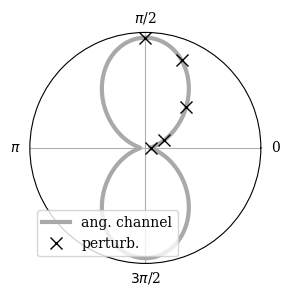
Compare calculation speed for one pair state and different set of angles#
The difference in calculation speed is due to the perturbative calculation having to re-run the full computations for all set of angles while the angular channel approach has to compute the angular channel values once and then simply reconstructs C6 value at different interatomic orientations.
It is even faster to load precalculated angular channel values from file if precalculated data exists, this method is shown further down.
[6]:
# set atom properties
atom = Cesium()
n, l, j, mj1 = 63, 0, 0.5, j
nn, ll, jj, mj2 = 90, 2, 2.5, jj

# set calculation propreties
nrange, dE = 10, 1*1e12
stateHop = False

# set theta values
theta_pert = np.linspace(0, np.pi/2, 5)
theta_lj = np.linspace(0, np.pi*2, 501)
phi = 0

# time array
times = []

# initialise PairStateInteractions class instance
calc = PairStateInteractions(atom, n, l, j, nn, ll, jj, m1=mj1, m2=mj2, interactionsUpTo=1)

# perturbative calculation
C6_pert = np.zeros_like(theta_pert)
times.append(time())
for i, theta in enumerate(theta_pert):
    C6_pert[i] = calc.getC6perturbatively(theta, phi, nrange, dE, degeneratePerturbation=False)
times.append(time())
print('calculation of {:.0f} values via perturbative approach: {:.1f} s'.format(len(theta_pert), times[1]-times[0]))

# angular channel code
times.append(time())
C6_lj = calc.getC6perturbatively_anglePairs([(theta, phi) for theta in theta_lj], nrange, dE, degeneratePerturbation=False, returnInteractionMatrix=False)[0]
times.append(time())
print('calculation of {:.0f} values via perturbative approach: {:.1f} s'.format(len(theta_lj), times[3]-times[2]))


# plot
fig = plt.figure(figsize=(3,3))
ax = fig.add_subplot(1,1,1, projection='polar')

# plot
ax.plot(theta_lj, C6_lj, color='darkgray', linewidth=3, label='ang. channel')
ax.plot(theta_pert, C6_pert, color='black', linestyle='none', marker='x', ms=9, label='perturb.')
ax.legend(bbox_to_anchor=(0,0), loc=3)
ax.set_xticks([0, np.pi/2, np.pi, 3*np.pi/2], ['0', r'$\pi$/2', r'$\pi$', r'$3\pi$/2'])
ax.set_yticks([])
calculation of 5 values via perturbative approach: 2.3 s
calculation of 501 values via perturbative approach: 2.9 s
[6]:
[]
Save angular channel values to file and load from file#
The precalculated data is stored as a hdf5 data object in the user’s local arc/data/C6_angularChannels_cache as angularChannel_precalcData.hdf5. Precalculated data for RbRb and CsCs angular channel coefficients are provided on Zenodo (https://zenodo.org/records/15006915). As a user, one can download the dataset via the loadAngularChannelData function to store it in the local cache (keyword: loadFromZenodo=True, file size: 15.9 MB). Additionally, one can compute the angular channel coefficients for other atomic species combinations or calculation settings via the calculateAngularChannelData function, these precalculated datasets are also stored on the user’s machine in the local precalc cache so that one can always access these precalculated datafiles when required. Setting the function’s keyword overwriteLocalData=True means that already existing local data for this pair state are overwritten. This can be useful e.g. when changing calculation settings to include higher-order multipole interactions, …
The cells shows how to load the precalculated data from Zenodo, and how to calculate an angular channel dataset that is stored locally, and how to access data in the local cache.
[4]:
# atom properties
l1, j1, s1 = 0, 0.5, 0.5
l2, j2, s2 = 2, 2.5, 0.5
atom1, atom2 = Rubidium(), Cesium()

# calculation properties
nRange = 10
energyDelta = 1e12
stateHopping = False
nValueRange = [20, 30]

# initialise calc.class, the initial state parameters do not matter
# as we will later pass our range of interest to the respective functions
calc = PairStateInteractions(Cesium(), 20, 0,0.5, 20,0,0.5, m1=0.5, m2=0.5, interactionsUpTo=1)


## calculate data and save in file
t1 = time()
status = calc.calculateAngularChannelData([l, j, 0.5, atom1], [ll, jj, 0.5, atom2], nValueRange, nRange, energyDelta, stateHopping=stateHop, overwriteLocalData=True)
t2 = time()
print('angular channel dataset precalculation, success?', status)
print('time requirement for calculation of {:.0f} pair state data: {:.1f} s.'.format((nValueRange[1]-nValueRange[0]+1)**2, t2-t1))


## load data from file
t1 = time()
atomInfos, coupledStates, data = calc.loadAngularChannelData([l, j, 0.5, atom1], [ll, jj, 0.5, atom2], stateHop, loadFromZenodo=False)
# reshape data to stack
data = np.reshape(data, (nValueRange[1]-nValueRange[0]+1, nValueRange[1]-nValueRange[0]+1, np.shape(data)[1]))
t2 = time()
print('time taken to load precalculated data: {:.3f} s'.format(t2-t1))

# print file metadata
print(atomInfos)
print(coupledStates)
print(np.shape(data))

# plot data
fig, ax = plt.subplots(1, len(coupledStates), figsize=(4.1*len(coupledStates),4))
for i, path in enumerate(coupledStates):
    ax[i].imshow(np.log10(np.abs(data[:,:, i+2])), origin='lower', extent=[*nValueRange, *nValueRange],
                 vmin=np.min(np.log10(np.abs(data[:,:,2:]))), vmax=np.max(np.log10(np.abs(data[:,:,2:]))))
    ax[i].set_title('#'+str(i+1))
fig.suptitle('Channel no.', fontsize=18)
[====================] 100%
Data was successfully saved to local cache.
angular channel dataset precalculation, success? None
time requirement for calculation of 121 pair state data: 5.9 s.
Data exists.
time taken to load precalculated data: 0.004 s
{'atom 1': 'Rb85', 'atom 2': 'Cs133', 'energyDelta': '1000000000000.0', 'interactionsUpTo': '1', 'j1': 0.5, 'j2': 2.5, 'l1': 0, 'l2': 2, 'nRange': '10', 'nValueRange': '[20, 30]', 'stateHopping': 'False'}
[[0.0, 0.5, 2.0, 2.5, 1.0, 0.5, 1.0, 1.5, 0.0, 0.5, 2.0, 2.5], [0.0, 0.5, 2.0, 2.5, 1.0, 0.5, 3.0, 2.5, 0.0, 0.5, 2.0, 2.5], [0.0, 0.5, 2.0, 2.5, 1.0, 0.5, 3.0, 3.5, 0.0, 0.5, 2.0, 2.5], [0.0, 0.5, 2.0, 2.5, 1.0, 1.5, 1.0, 1.5, 0.0, 0.5, 2.0, 2.5], [0.0, 0.5, 2.0, 2.5, 1.0, 1.5, 3.0, 2.5, 0.0, 0.5, 2.0, 2.5], [0.0, 0.5, 2.0, 2.5, 1.0, 1.5, 3.0, 3.5, 0.0, 0.5, 2.0, 2.5]]
(11, 11, 8)
[4]:
Text(0.5, 0.98, 'Channel no.')

Look behind the scenes - how does angular channel code work?#
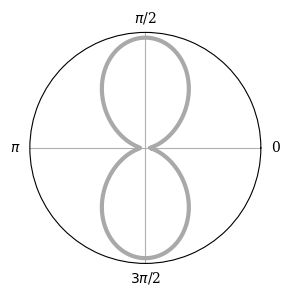
Effectively, the angular channel code runs the perturbative calculation to compute the angular channel values once and then implements the angular orientation. One can also do this manually by calculating the angular channel strengths, then calculate the full interaction matrix at theta = 0 and finally rotate the interaction matrix to the actual relative interatomic orientation with Wigner-D matrices.
In the following, we will go through the whole angular momentum channel procedure in detail to demonstrate the steps that happen behind the scenes in the functions. Note, though, that this only shows the case where the atoms return to their initial state.
[5]:
# set atom properties
atom1, atom2 = Cesium(), Cesium()
n, l, j, mj1, s1 = 63, 0, 0.5, j, 0.5
nn, ll, jj, mj2, s2 = 90, 2, 2.5, jj, 0.5

# set calculation propreties
nrange, dE = 10, 1*1e12
stateHop = False

# set angles
theta_lj = np.linspace(0, np.pi*2, 501)
phi = np.pi/4

# initialise PairStateInteractions class instance
calc = PairStateInteractions(atom, n, l, j, nn, ll, jj, m1=mj1, m2=mj2, interactionsUpTo=1)


## find all coupled angular channels
coupledStates = calc._findAllCoupledAngularMomentumStates(l,j,s1, ll,jj,s2, stateHopping=stateHop)
if coupledStates == []:
    raise ValueError("No interaction pathways found for the specified conditions.")


## calculate angular channel values, together with channel information
channelData = []
for pathway in coupledStates:
    V_lj = calc._calcLJcontribution_allParamsFree(pathway, [n,s1, atom1], [nn,s2, atom2],
                                                  nrange, dE, stateHop, interactionsUpTo=1)
    channelData.append([*pathway, V_lj])


## for all channels, construct the channel's interaction matrix and sum up to get total Imat
# this can also be done by feeding the channelData list into the _getPerturbativeC6Matrix_lj function
#Imat = calc._getPerturbativeC6Matrix_lj(channelData)

Imat = 0
# iterate through channels
for vals in channelData:
    # construct mj-resolved transition matrix for first and second dipole transition
    d1 = calc._getd(*vals[0:8])
    d2 = calc._getd(*vals[4:12])
    # construct mj-resolved transition matrix for full process
    D = d2.dot(d1)
    # add channel to overall Imat
    Imat += vals[-1]*D


## Now that we have the interaction matrix at theta = 0, rotate to desired angles
## via Wigner matrices and save C6 value from that angle for given (mj1, mj2) pair

C6 = []

# get array indexing the 2-atom composite state in (mj1, mj2) basis
compState = compositeState(singleAtomState(j, mj1), singleAtomState(jj, mj2)).T
# alternatively: get index via mjInd = (j+mj1)*(jj+mj2) and then select via index rather than by state mul.

# iterate through angles
for theta in theta_lj:
    # Wigner D matrix allows calculations with arbitrary orientation of the two atoms
    wgd = WignerDmatrix(theta, phi)
    angRotationMatrix = np.kron(wgd.get(j).toarray(),wgd.get(jj).toarray())

    # rotate Imat's into correct basis for angles theta, phi (angle1, angle2)
    Imat_rot = angRotationMatrix.dot(Imat.dot(angRotationMatrix.conj().T))

    # get C6 value for the correct initial and final (mj1, mj2) combination
    C6val = np.real(compState.dot(Imat_rot.dot(compState.T)))[0][0]
    C6.append(C6val)


## plot results
fig = plt.figure(figsize=(3,3))
ax = fig.add_subplot(1,1,1, projection='polar')

# plot
ax.plot(theta_lj, C6, color='darkgray', linewidth=3)
ax.set_xticks([0, np.pi/2, np.pi, 3*np.pi/2], ['0', r'$\pi$/2', r'$\pi$', r'$3\pi$/2'])
ax.set_yticks([])
[5]:
[]
Study composition of C6 into angular channels#
We will do the same procedure as above, but this time resolve the different angular channels so that one can see how the resulting C6 is composed of a sum of the different angular channels.
[6]:
# set atom properties
atom1, atom2 = Cesium(), Cesium()
n, l, j, mj1, s1 = 63, 0, 0.5, 0.5, 0.5
nn, ll, jj, mj2, s2 = 90, 2, 2.5, 2.5, 0.5

# set calculation propreties
nrange, dE = 10, 1*1e12
stateHop = False

# set angles
theta_lj = np.linspace(0, np.pi*2, 501)
phi = np.pi/4

# initialise PairStateInteractions class instance
calc = PairStateInteractions(atom, n, l, j, nn, ll, jj, m1=mj1, m2=mj2, interactionsUpTo=1)


## find all coupled angular channels
coupledStates = calc._findAllCoupledAngularMomentumStates(l,j,s1, ll,jj,s2, stateHopping=stateHop)
if coupledStates == []:
    raise ValueError("No interaction pathways found for the specified conditions.")


## calculate angular channel values, together with channel information
channelData = []
print('angular channels (l, j, ll, jj each for init, interm. fin) and associated channel value C^(lj)')
for pathway in coupledStates:
    V_lj = calc._calcLJcontribution_allParamsFree(pathway, [n,s1, atom1], [nn,s2, atom2],
                                                  nrange, dE, stateHop, interactionsUpTo=1)
    channelData.append([*pathway, V_lj])
    print(pathway, 'with C^(lj) = {:.3f} GHz um^6'.format(V_lj))


## for all channels, construct the channel's own Imat and plot. Later, sum up all channel's Imats to get overall C6, plot

# create figure and axis instance
fig = plt.figure(figsize=(7.5, 3.5))
gs = GridSpec(1,2, wspace=0.2)
ax = []
for i in range(2):
    ax.append(fig.add_subplot(gs[i], projection='polar'))

# get array indexing the 2-atom composite state in (mj1, mj2) basis
compState = compositeState(singleAtomState(j, mj1), singleAtomState(jj, mj2)).T
# alternatively: get index via mjInd = (j+mj1)*(jj+mj2) and then select via index rather than by state mul.

# compute Wigner-D matrices for specified angles to avoid having to compute them multiple times
wigD = np.zeros((int((2*j+1)*(2*jj+1)),int((2*j+1)*(2*jj+1)),len(theta_lj)), dtype=complex)
for i, theta in enumerate(theta_lj):
    wgd = WignerDmatrix(theta, phi)
    wigD[:,:,i] = np.kron(wgd.get(j).toarray(), wgd.get(jj).toarray())

C62 = np.zeros(len(theta_lj))

# iterate through channels
for i, vals in enumerate(channelData):
    # construct mj-resolved transition matrix for first and second dipole transition
    d1 = calc._getd(*vals[0:8])
    d2 = calc._getd(*vals[4:12])
    # construct full mj-resolved transition matrix for channel
    Imat_lj = vals[-1]*d2.dot(d1)

    C6_lj = np.zeros(len(theta_lj))

    # iterate through angles
    for k, theta in enumerate(theta_lj):
        # get correct Wigner-D matrix
        angRotationMatrix = wigD[:,:,k]

        # rotate Imat's into correct basis for angles theta, phi (angle1, angle2)
        Imat_rot = angRotationMatrix.dot(Imat_lj.dot(angRotationMatrix.conj().T))

        # get C6 value for the correct initial and final (mj1, mj2) combination
        C6val = np.real(compState.dot(Imat_rot.dot(compState.T)))[0][0]
        C6_lj[k] = C6val

    # plot into polar plot
    ax[0].plot(theta_lj, np.where(C6_lj > 0, C6_lj, np.nan), ls='solid', lw=3, color=(i/len(channelData), 0.3, 1-i/len(channelData))) # >0: solid line
    ax[0].plot(theta_lj, np.where(C6_lj < 0, -C6_lj, np.nan), ls='dashdot', lw=3, color=(i/len(channelData), 0.3, 1-i/len(channelData))) # <0: dashdot


    #add to overall C6
    C62 += C6_lj

# print max. C6 value
print('\n max. |C6| value for mj1={:.1f} and mj2={:.1f} is {:.3f} GHz um^6'.format(mj1, mj2, np.max(np.abs(C6))))


## plot overall C6
ax[1].plot(theta_lj, C62, color='darkgray', linewidth=3)
for axis in ax:
    axis.set_xticks([0, np.pi/2, np.pi, 3*np.pi/2], ['0', r'$\pi$/2', r'$\pi$', r'$3\pi$/2'])
    axis.set_yticks([])
angular channels (l, j, ll, jj each for init, interm. fin) and associated channel value C^(lj)
(0, 0.5, 2, 2.5, 1, 0.5, 1, 1.5, 0, 0.5, 2, 2.5) with C^(lj) = 100.978 GHz um^6
(0, 0.5, 2, 2.5, 1, 0.5, 3, 2.5, 0, 0.5, 2, 2.5) with C^(lj) = 46.500 GHz um^6
(0, 0.5, 2, 2.5, 1, 0.5, 3, 3.5, 0, 0.5, 2, 2.5) with C^(lj) = 46.500 GHz um^6
(0, 0.5, 2, 2.5, 1, 1.5, 1, 1.5, 0, 0.5, 2, 2.5) with C^(lj) = 37.045 GHz um^6
(0, 0.5, 2, 2.5, 1, 1.5, 3, 2.5, 0, 0.5, 2, 2.5) with C^(lj) = -72.895 GHz um^6
(0, 0.5, 2, 2.5, 1, 1.5, 3, 3.5, 0, 0.5, 2, 2.5) with C^(lj) = -72.895 GHz um^6

 max. |C6| value for mj1=0.5 and mj2=2.5 is 1.102 GHz um^6

For those who want to play around with angular channels to learn more:#
The function _calcLJcontribution_allParamsFree allows the user complete freedom over all parameters that could be varied.
[5]:
print(getCitationForARC())
- N. Šibalić, J. D. Pritchard, K. J. Weatherill, C. S. Adams, ARC: An open-source library for calculating properties of alkali Rydberg atoms, Computer Physics Communications 220, 319 (2017), https://doi.org/10.1016/j.cpc.2017.06.015
- Karen Wadenpfuhl, C. Stuart Adams, Unravelling the Structures in the van der Waals Interactions of Alkali Rydberg Atoms, arXiv:2412.14861, https://arxiv.org/abs/2412.14861
[ ]: